
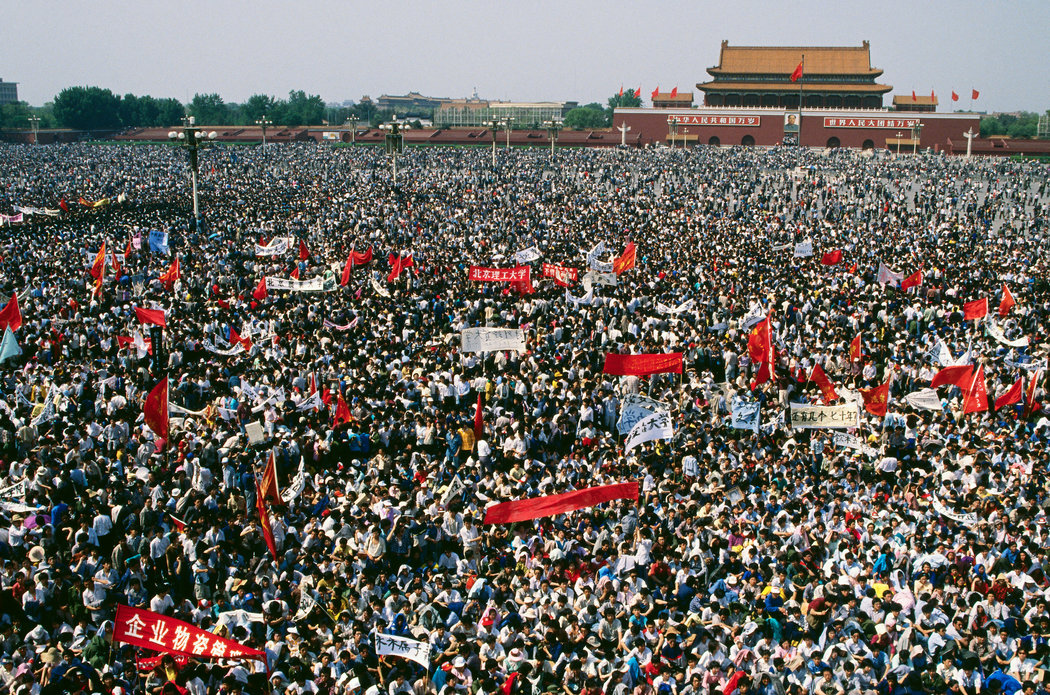
Introduction: A Lost Turning Point
In the early summer of 1989, China stood on the edge of an historic decision. Ten years of market reform had already unleashed productivity and social mobility unseen since the late Qing. What remained unresolved was whether the country would pair its economic opening with political reform — or entrench authoritarian control to preserve one-party dominance. The leadership chose the latter, responding to popular demands for accountability with live ammunition in Tiananmen Square.
The massacre froze political liberalization for a generation. Yet history does not move only one way. Across Asia, other late-industrializing states — South Korea, Taiwan, and parts of Southeast Asia — proved during the same period that controlled democratization could coexist with stability and growth.
This analysis considers how a counterfactual democratic China might have evolved by 2025 if the 1989 movement had led to ballots instead of bullets. The scenario is not utopian. It draws from regional precedents, economic data, and institutional logic to examine how China’s governance, economy, society, and global position might differ today.
Politics and Institutions: From Control to Competition
The most realistic democratic pathway for China after 1989 would not have been a revolutionary collapse of the Communist Party but a gradual transition through controlled pluralization — a model closer to South Korea’s in the late 1980s or Taiwan’s under Chiang Ching-kuo and Lee Teng-hui.
Phase One (1990s): Institutional Opening
Beijing could have legalized independent civic groups, professional associations, and local media while expanding the already-existing village elections introduced under the Organic Law of 1987. Provincial People’s Congresses might have gained investigatory powers and limited budgetary autonomy, creating competition within the system rather than against it.
Phase Two (2000s): Constitutional Reform and Party Adaptation
As in Taiwan’s Kuomintang, the Chinese Communist Party (CCP) might have redefined itself as a broad national party competing in elections while tolerating opposition forces. The National People’s Congress could evolve into a genuine legislature, with a constitutional court established to interpret and protect fundamental rights.
Elite incentives would change: career advancement would depend on electoral performance, policy innovation, and administrative competence rather than factional loyalty. Bureaucratic professionalism — already valued under technocrats like Zhu Rongji — would deepen through meritocratic but accountable governance.
Phase Three (2010s–2020s): Democratic Consolidation
By the 2010s, China could plausibly hold competitive national elections under a hybrid parliamentary-presidential system. Political alternation might be messy, but corruption and maladministration would face real exposure through courts, media, and legislative scrutiny.
Crucially, nationalism would remain, but it would be balanced by public demand for transparency and performance. Leaders would no longer be able to instrumentalize “stability maintenance” to suppress accountability. The state’s legitimacy would rest not on control of information but on the capacity to deliver services and respond to public pressure.
Compared to the real China of 2025 — a state of pervasive surveillance, censorship, and insecurity — a democratic China would still be authoritarian in temperament but constitutional in form, similar to South Korea’s mix of strong executive power and civil participation.
Economy: Growth with Accountability
Economically, China’s fundamentals in 1989 were already robust: GDP per capita around US$350 (World Bank) and annual growth exceeding 10%. Market reform, however, was constrained by political risk and property insecurity. A democratized China would likely have accelerated, not slowed, economic transformation.
Market Institutions and Property Rights
Political liberalization would have enabled the creation of independent courts, banking regulation, and corporate governance frameworks comparable to those Taiwan built in the 1990s. Private entrepreneurs, freed from arbitrary expropriation, could plan long-term. Foreign direct investment (FDI) — which in reality surged after WTO accession in 2001 — might have diversified earlier and spread beyond coastal zones.
With more transparent public finances, local governments would rely on tax revenues rather than speculative land sales, avoiding the debt trap that by 2025 exceeds 90% of GDP when off-balance-sheet obligations are counted.
Industrial and Innovation Policy
Without the dominance of state-owned enterprises (SOEs), China’s industrial landscape would have looked closer to South Korea’s chaebol-to-market evolution: large conglomerates disciplined by open competition and independent audit.
Innovation policy would prioritize small and medium-sized enterprises and research partnerships rather than political campaigns such as “Made in China 2025.” Venture capital and private R&D — currently only 20% of total national research spending — could have reached parity with public funding.
Social Balance and Consumption
A more accountable government might have rebalanced the economy toward domestic consumption earlier. By the mid-2000s, social protection spending could reach 15–20% of GDP, aligning with OECD norms, mitigating China’s reliance on export-driven, investment-heavy growth.
Debt problems and demographic aging would still exist, but policy correction would come earlier and more transparently. In this counterfactual scenario, China’s 2025 GDP might be smaller in absolute terms than today’s US$17 trillion reality, yet income per capita could approach US$25,000 — roughly South Korea’s level — rather than the actual US$13,000.
The key difference is efficiency of governance: democracy imposes fiscal restraint through parliamentary oversight and a free press, while authoritarianism hides misallocation until it becomes systemic.
Education and Civic Mindset: Building Citizens, Not Subjects
China’s educational transition in the 1980s already pointed toward diversification. Under democratization, this shift would have expanded dramatically, shaping civic behavior across generations.
Educational Reform and Academic Autonomy
Universities would enjoy autonomy in governance and curriculum design. Political study sessions and ideological campaigns would give way to civic education, public administration, and international law. Humanities and social sciences — disciplines that encourage analytical thinking — would thrive alongside engineering.
Academic exchange with global institutions would deepen. Instead of the present “knowledge firewall,” Chinese scholars would remain fully embedded in international research networks.
Socialization of Democratic Norms
Education’s greatest impact lies in social norms. Students exposed to open debate and competing ideas tend to develop tolerance and self-restraint. Over time, civic education fosters expectations of procedural fairness — the belief that power must be exercised through transparent and lawful means.
By 2025, a generation raised in such a system would demand responsiveness from government and media alike. Volunteerism, NGO participation, and community organizing — already emerging in 1980s China — would become common forms of political engagement.
The Contrast with Reality
In today’s China, education serves the state’s ideological monopoly. The re-imposition of political study, censorship of universities, and surveillance of teachers have reversed decades of openness. A democratic China would instead cultivate civic capital — the trust, pluralism, and initiative that undergird both innovation and stability.
Technology and Innovation: Freedom as a Catalyst
Economic transformation depends not only on policy but on intellectual climate. Under democracy, China’s innovation system would be freer, risk-tolerant, and globally integrated.
Research Freedom and Global Integration
Without censorship and party oversight, universities could engage in politically sensitive research in social sciences and cutting-edge technologies. Joint laboratories with American, European, and Japanese partners would expand beyond applied engineering into governance, law, and digital ethics.
China’s role in global technology standards — 5G, semiconductors, AI — would grow through participation, not confrontation. Instead of sanctions and export bans, a trusted China would co-lead international consortia similar to the EU’s Horizon programs.
Private Sector and Regulation
Tech giants such as Huawei or Alibaba would emerge earlier but operate under democratic regulation: strict antitrust laws, privacy protections, and parliamentary scrutiny. Their innovation would arise from market competition rather than state favoritism.
The result would be a more sustainable innovation ecosystem — less distorted by geopolitical suspicion, more aligned with global norms.
Comparative Evidence
The pattern matches South Korea’s post-1987 trajectory: democratization coincided with a surge in patent output, R&D intensity (from 1.6% of GDP in 1987 to 4.8% today), and the rise of globally trusted brands. Freedom proved not a distraction but a multiplier of creativity.
Hong Kong: From “One Country, Two Systems” to One Democratic Nation
In this alternative China, Hong Kong’s story diverges completely.
Post-1997 Integration under Democracy
If Beijing had democratized through the 1990s, the 1997 handover would not require a firewall between systems. Instead, “One Country, Two Systems” would evolve naturally into “One Country, One Democratic Framework.”
Hong Kong’s Basic Law could serve as a prototype for a national constitution: separation of powers, independent courts, and protection of civil liberties. Rather than an exception, Hong Kong’s freedoms would become a national standard.
Economic and Institutional Role
The city would retain its role as China’s financial and legal gateway, but within a transparent, accountable federation. Its universities would remain global leaders, its media independent but responsible. Civil organizations could network openly with counterparts across the mainland, supporting professional governance and policy experimentation.
In this environment, Hong Kong would likely surpass Singapore as Asia’s premier hub for finance, culture, and higher education. A generation of mainland students and professionals would flow into the city for training — not to escape censorship, but to participate in an open Chinese democracy.
The Contrast with Reality
Instead, after 2020’s National Security Law, Hong Kong’s press freedom ranking has collapsed from 18th (2002) to 135th (2025, RSF data). Emigration of professionals exceeds 250,000. What could have been the moral capital of Chinese modernity is now a managed enclave of silence.
In a democratic China, Hong Kong would not need to defend its freedoms — it would embody them.
Taiwan: From Threat to Partner
Under democracy, Beijing’s relationship with Taipei would be transformed from ideological rivalry to constitutional negotiation.
Domestic Politics and Public Opinion
Democratic competition in China would domesticate nationalism. Politicians appealing to voters would find coercive unification policies unpopular among a middle class wary of war’s costs. Public discourse, shaped by independent media, would emphasize diplomacy and mutual benefit.
Cross-Strait Relations
Relations could evolve similarly to West Germany’s Ostpolitik: peaceful engagement, economic interdependence, and gradual institutional convergence. Trade and mobility would bind the two economies, while cultural dialogue reframed identity politics.
Taiwan would remain autonomous, but existential insecurity would fade. The “Taiwan problem” would cease to be a potential flashpoint for great-power conflict and instead resemble the EU’s internal constitutional challenges — complex, emotional, but non-violent.
Strategic Implications
The existence of two Chinese democracies — one continental, one island — would redefine East Asia. Instead of a confrontation between an authoritarian China and a democratic alliance, the region would host a triangle of democracies: Japan, Taiwan, and China. Their relations would still involve competition, but grounded in law and mutual restraint.
International Order: A Democratic China in the World
A democratic China would still be a global power — industrial, technological, and military — but not a revisionist one. Its integration into international institutions would deepen rather than destabilize them.
U.S.–China Relations
Rivalry would persist, but over economic policy rather than ideology. Washington’s containment strategy would shift to cooperation on global governance, climate policy, and trade norms. Military tension in the Indo-Pacific would ease as transparency reduced misperception.
Asia and the Global South
For Asian neighbors, a democratic China would be less threatening and more instructive. ASEAN states, India, and others could interact with Beijing through open regional institutions, balancing competition with trust.
Across Africa and Latin America, China’s Belt and Road model would prioritize rule-of-law investment and local accountability, countering corruption rather than entrenching it. The narrative that authoritarianism guarantees growth would collapse.
Global Ideological Impact
The world would not be free of conflict, but the dividing line between liberal and illiberal systems would blur. A democratic China would demonstrate that size need not preclude freedom, undermining the ideological polarization defining the 21st century.
Conclusion and Looking Forward: The Path Not Taken
The tragedy of 1989 was not only the massacre itself but the lost future it symbolized. China’s choice of repression over reform froze the political evolution that could have accompanied its economic rise.
A democratizing China might have produced a more moderate nationalism, a more balanced economy, and a more trusted global image. Hong Kong could have remained a beacon of Chinese modernity; Taiwan, a partner rather than a problem. The world might still debate China’s influence, but within the grammar of democracy, not the fear of coercion.
As of 2025, China remains powerful yet anxious, rich yet insecure — a superpower that fears its own citizens. The decision made thirty-six years ago still shapes its destiny.
History rarely offers second chances, but it sometimes offers reminders. The students in Tiananmen asked not for revolution but for reform, not for the end of China but for its renewal. In that sense, the question remains open: whether another generation, in another moment of crisis, might choose ballots over bullets — and finally complete the transformation 1989 began.